
 A fig’s shape may seem mostly cosmetic, but it can influence something far more important: how well the fruit handles rain and humidity.
For growers in the Carolinas and other humid regions, splitting can turn an otherwise exceptional fig into an unreliable crop. Research confirms that cracking and splitting vary by cultivar and can shorten shelf life by creating pathways for decay.
That makes fruit shape, skin characteristics and even the way a fig hangs from its branch important traits for Bethel Grove Gardens’ future breeding work.
Figs Come in Surprisingly Different Shapes
Fig varieties aren’t simply “round” or “pear-shaped.”
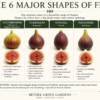
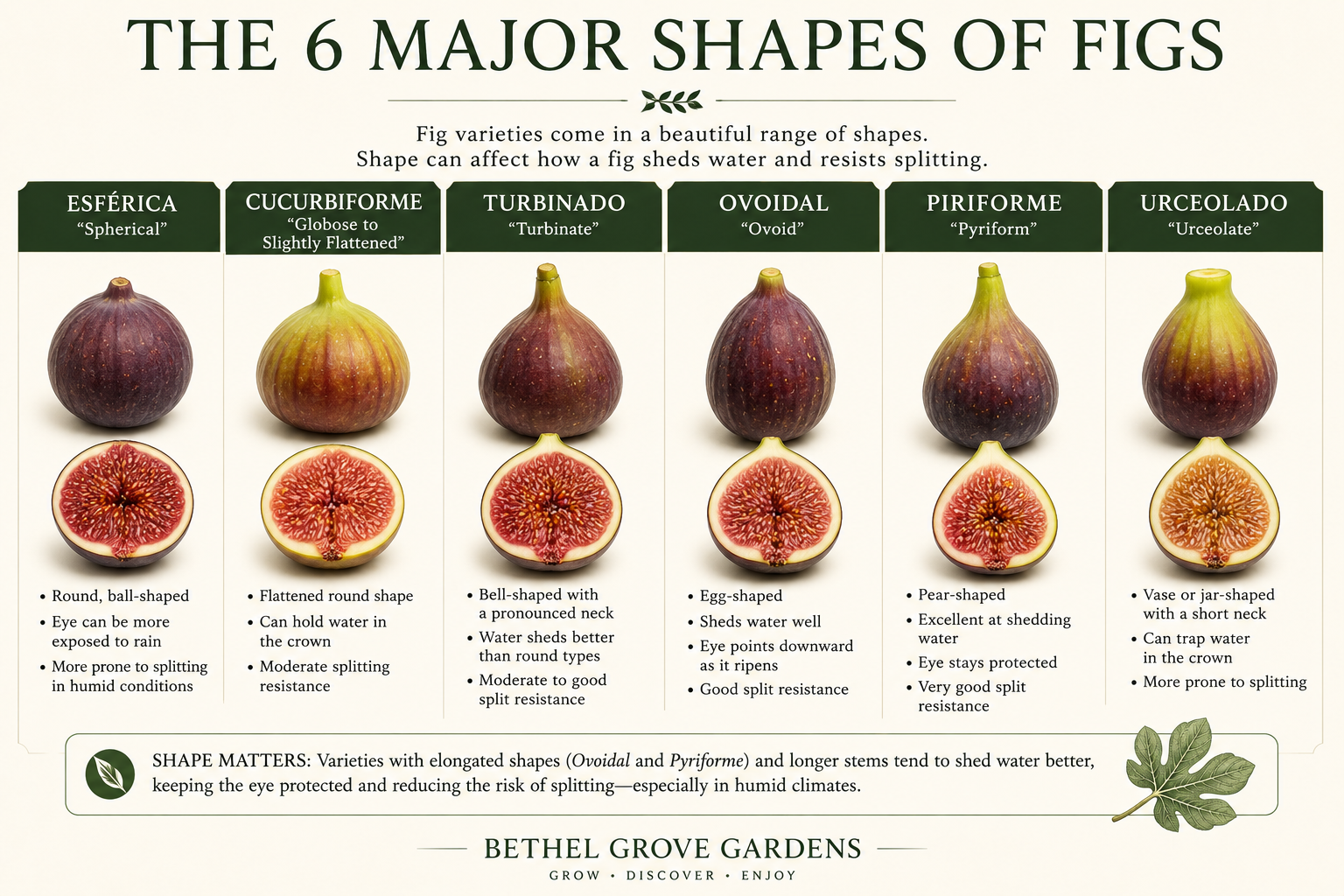
Traditional fig descriptions recognize several forms, including spherical, ovoid, turbinate, pyriform and other intermediate shapes. Ira Condit’s landmark Fig Varieties: A Monograph routinely used fruit shape, neck and stalk characteristics when distinguishing cultivars.
Those differences can be remarkably useful for identifying varieties because basic fruit morphology is strongly influenced by genetics.
For humid-climate growers, however, shape may have another potential advantage.
Longer, more ovoid or pear-shaped figs can present surfaces that shed rainwater, particularly when the fruit hangs downward. Rounder fruits or shapes that create areas where water remains could theoretically remain wet longer.
That doesn’t mean every pear-shaped fig resists splitting or every round fig cracks. Shape is only part of a much more complicated equation.
Why Figs Split
Splitting occurs when the fig’s expanding interior exceeds what its skin can withstand.
Water plays an important role. Modern horticultural research describes fruit cracking as an interaction among water movement, internal pressure, skin properties, genetics and environmental conditions.
Research specifically involving figs found that reducing irrigation decreased skin cracking and ostiole-end splitting in susceptible cultivars. In one study, regulated deficit irrigation increased marketable fruit by 50% in Brown Turkey and 18% in Sierra.
The variety itself matters considerably, too.
Researchers found different levels and types of damage among Brown Turkey, Kadota, Sierra and Black Mission.
The Fig’s Eye May Be Even More Important
At the bottom of every fig is the ostiole, commonly called its eye.
Botanically, a fig is a hollow structure called a syconium containing numerous flowers internally. The ostiole provides the small opening into that structure.
For growers, that opening can become a vulnerability.
Ostiole-end splitting exposes the fig’s interior, while cracks and splits can provide entry points for decay organisms.
That’s why the orientation of a ripening fig deserves attention.
A long stem, flexible neck and elongated fruit can potentially allow a fig to droop downward as it ripens. That places the eye in a more protected orientation and may help water drain away instead of collecting around it.
But this relationship needs more controlled research before fruit shape or hanging angle alone can be treated as proven predictors of splitting.
Breeding a Better Fig for the Southeast
These characteristics are particularly interesting for Bethel Grove Gardens’ fig breeding program.
Exceptional flavor alone won’t necessarily make an exceptional Carolina fig.
Our summers combine heat and humidity with heavy rain that can arrive just as fruit approaches peak ripeness. A variety that performs beautifully in a dry Mediterranean climate may behave very differently here.
That means future Bethel Grove seedlings can be evaluated for an entire package of characteristics:
- Fruit shape and hanging angle
- Small or tightly closed eye
- Longer stem and favorable neck structure
- Elastic, durable skin
- Resistance to cracking and splitting
- Ability to shed rainwater
- Flavor, acidity and sweetness
- Early and reliable ripening
Some of those characteristics may ultimately prove more important than others.
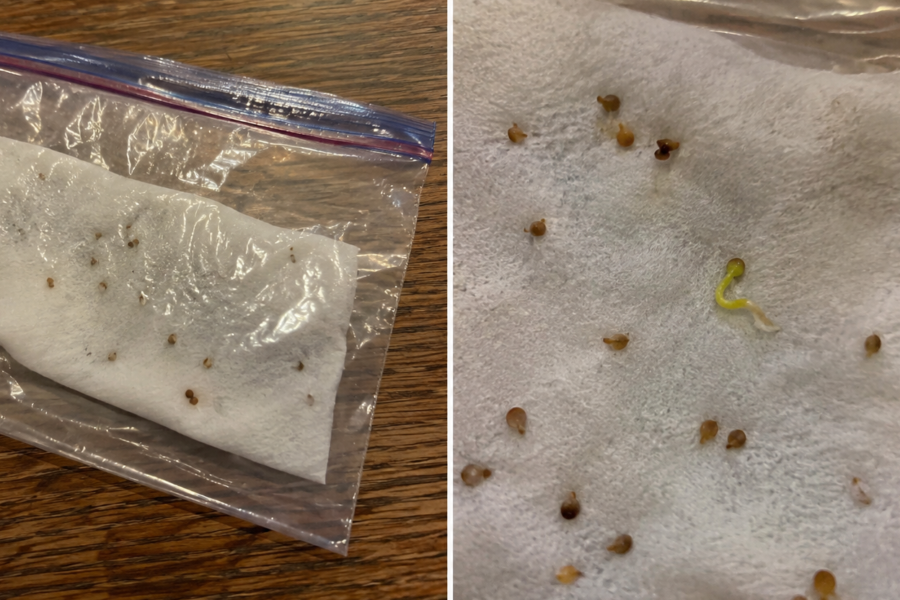
That’s part of the reason we’re growing seedlings rather than simply collecting existing varieties.
Our goal is to identify the combinations that work.
A future Bethel Grove fig might therefore be selected not only because it tastes extraordinary, but because its shape, skin and structure help protect that flavor through a Carolina summer.
That is exactly the type of small biological detail that could ultimately help create a better regional fig.